
REVIEW: Red Rising
Red Rising was a book that took 40 pages to actually get interesting.
After I finished Words of Radiance and Mark of the Fool, from my last review, I wanted to dive into something with more substantial plot, and nothing felt like a better target than the book I read once and called mid. Really, the only boring part was the beginning — everything up to when Eo sings, and gets hung as a result. But, from what I’ve heard, that’s somehow reflective of the entire series!
Everyone **sings the praises of the entire Red Rising series, and while this one’s a good start as a series opener, it’s also still considered the worst of the series, because everything that comes after is just that good.
This book is the same, within its own plot.
It could’ve just been me, but the entire beginning portion feels like a buffer that slows me down, both when I first read and even now, when I returned to reread it. Even as I’ve tried to recommend it to my brother, I don’t think he’s made it past the beginning yet!
Yet, on a reread, knowing what comes next — that Mars has been colonized and the Reds are slaves — it’s fascinating to see just how much Darrow was drinking the koolaid. What comes off as typical worldbuilding details, that the Reds are mining for helium-3 to power human colonization, when you know that it’s all a lie, it makes you experience firsthand just how fundamentally they’ve been indoctrinated.
That’s also a key detail to emphasize: this is a reread. I have no idea how long ago I first read Red Rising, but somehow, I thought it was just okay. I thought it was just like the Hunger Games, and that the plot was essentially the same setup of teenagers put into a survival tournament to the death.
Safe to say, hindsight isn’t always 20/20.
I was bloodydamn wrong.
RED RISING — 5/5 STARS
Red Rising is grounded, yet so much more raw and dramatic than anything else I’ve read. The writing style, on a surface level, can be pretty simple and heavy-handed, but painting the events of what actually happens with such a heavy-handed tone makes it a thousand times more dramatic, like how Greek myths would get written with such dramatic verbage to paint their legends.
Not dramatic in the sense that it’s flowery and dresses things up with excessive details, but in the sense that, for example, the flying city where the proctors watched the students is called Olympus, just so that Darrow can have the chance to say “They took SPOILER. So we take Olympus.”
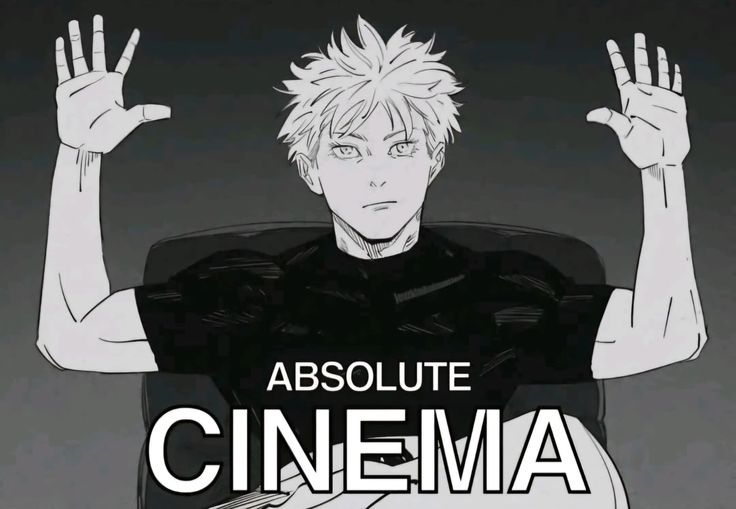
This book was filled with moments just as dramatic or cutthroat. When Darrow is locked in a room alone with Julius and told he has to fight to the death to continue, sure enough, with no cuts, Darrow beats another kid to death.
Titus, in one go, lassos a girl, drags her through the mud on the back of his horse like Carlos in Saints Row 2, then brands her with hot iron.
They starve, they become animals, they get desperate and evil, and they lie.
Knowing what happened to Julius, I hated how much I started to love Cassius as a character, because watching Darrow continue to lie to him about what happened, despite how close they were, was so gut-wrenching.
Even then, Darrow was lowkey an idiot. How did he get led alone into the forest into a trap twice? First Antonia, with claiming Roque was alive, and then Cassius, too?
I’m almost glad for his idiocy, though, because what followed — Cassius revealing the truth, Darrow thinking he was dying at his best friend’s hand — was peak. That was my second favorite period of the book, when Darrow “died” and woke up thinking that Mustang was Eo, reflecting on everything up to now, with the entire passage about how much he hates everything and everyone.
Even her.
The evolution of how he felt about Eo’s thoughts was so undercut, I didn’t realize it until the point when he remembered that Eo had been dead longer than they were ever married. Before and immediately after she died, he thought about her in almost every other paragraph — Eo this, Eo that — but then after a certain point, once he realizes that she’s gone gone, that he’s hurting himself this much for someone that’ll never know, she stopped getting mentioned.
I also realize, as I write this, that I lied about that being my second-favorite moment. Too much happens in this book, and every time I thought something was the best part, it got better. The first confrontation with Apollo and the trap triggered by the line “how fast can Sevro run?” was a highlight that had me jumping with hype.
Then, Chapter 41 hit.
THE JACKAL.
They talked about The Jackal like he was King Von reincarnated. In one singular chapter, he’s revealed, he cuts off his own hand, PAX DIES, and then Darrow fights AND KILLS Apollo, before declaring war on Olympus itself to save Mustang. I take notes of things to make videos about as I read, and that chapter just came out like:
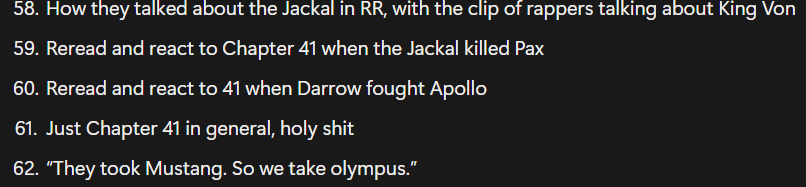
Now, character-wise, Sevro was a favorite for sure. His getback on the Jackal after hearing Cassius’s lie, immediately rushing off to run the 1’s, was so crazy to read about. I don’t know how he counts as a Gold, how he’s meant to lead men into glorious battle, cause Sevro is meant for black ops. He WILL commit war crimes. I know this series moves to an intergalactic scale, and I’m almost afraid, ‘cause I know Sevro is too good to become irrelevant, and I don’t know what he’ll do.
This is ultimately a book about someone becoming what they hate to destroy their enemies, yet embodying that hate and fear and using it as a weapon for himself. It was so good, I bought the next PHYSICALLY.
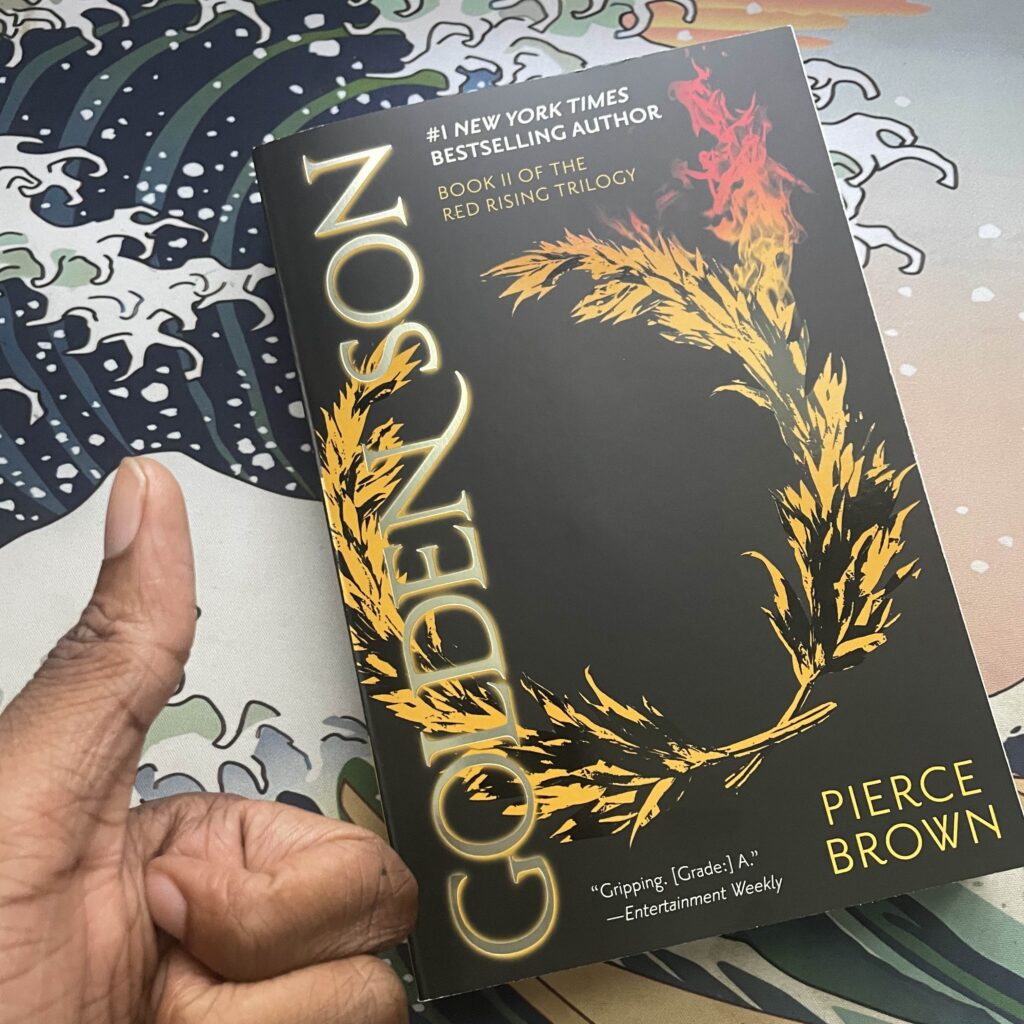
I’m low on shelf space, so I usually read a series digitally, but I know full well that when I dive into Golden Son, it’s gonna grab me like a black hole. Until it does, I’m putting it off for trying something different, some genuinely lighter reading.
Like Azarinth Healer, the book I got halfway through before ultimately DNFing it.
Why?